
Why provider activation belongs in your Star Ratings strategy.
A health plan identifies an overdue screening. The member receives a reminder. But completing the screening may still require a conversation with the care team, an order, help scheduling, and follow-up after a missed appointment.
Member outreach starts that process. Provider activation helps connect the steps.
For Star Ratings leaders, the opportunity is to bring the plan and practice into a more coordinated workflow. The plan contributes information about care needs across its population. The practice brings clinical context, a patient relationship, and the ability to arrange care. Members benefit when those efforts reinforce each other.
Research supports that coordinated approach. It also offers a useful caution: sending more reminders—to members or clinicians—does not automatically produce better results.
Member outreach works but leaves work unfinished
Direct-to-member outreach can improve screening participation.
In the BeneFIT study, two health plans mailed fecal immunochemical test (FIT) kits to Medicaid and Medicare enrollees overdue for colorectal cancer screening. FIT completion was approximately 18% among groups mailed kits. Those results demonstrated the potential of plan-led outreach while leaving substantial opportunity for additional follow-through.[1]
A randomized trial by Sequist and colleagues found that mailed educational materials, stool-testing kits, and scheduling instructions increased colorectal cancer screening from 38.1% to 44.0% over 15 months—a 5.9-percentage-point improvement.[2]
These findings support continued investment in member outreach. They do not establish a universal ceiling on its effectiveness. Results depend on the population, intervention, and support available after the first contact.
The practical question is what happens when a reminder is not enough. A member may need an explanation of the screening options, help arranging transportation, or confirmation that the recommendation still applies. Someone must recognize that need and take responsibility for the next step.
The practice brings a relationship and a path to care
In KFF’s January 2025 poll, 85% of U.S. adults said they trusted their own doctor a great deal or a fair amount to make the right health recommendations.[3]
That finding points to an asset quality programs should support: the relationship between patients and their clinicians. It does not measure trust in health plans or prove that a practice-branded message will outperform a plan’s outreach.
Provider activation also extends beyond who delivers the message. A care team can help interpret the recommendation, determine whether care has already occurred, arrange an appointment, and identify barriers that a mailing cannot resolve.
That work may involve a nurse practitioner, physician assistant, nurse, care coordinator, or scheduling team. Effective engagement reaches the person responsible for the task and gives that person a manageable way to act.
Plans and practices may also hold different pieces of the same story. A plan’s gap list may show a missing service, while the practice documents completed care. Connecting those perspectives helps teams determine whether the member needs care, the plan needs evidence, or both need updated information.
Coordinated reminders can connect intention with completion
A 2026 randomized trial at Kaiser Permanente Washington illustrates the potential of a coordinated workflow.
Among 1,837 participants due for repeat lung cancer screening, a “Stepped Reminders” intervention prompted primary care physicians to order scans and then used patient messages, mailed letters, and telephone follow-up to support scheduling. Screening adherence was 75.5% with Stepped Reminders versus 47.4% without them—a 28.1-percentage-point difference.[4]
The intervention connected a clinical action with patient follow-through. Additional educational communication, tested separately, did not improve adherence.
This was a lung cancer screening study in an integrated health system, not a test of Star Ratings performance or careMESH. Its practical relevance is the workflow: timely clinician action paired with patient outreach and help completing the next step.
Provider reminders need a workflow behind them
Provider activation is not simply another alert campaign.
In Sequist’s colorectal screening trial, physician reminders did not significantly improve screening overall, even though patient mailings did.[2] A systematic review of 28 trials found that point-of-care computer reminders produced a median absolute improvement of 4.2 percentage points in care processes.[5]
The lesson for health plans is to make participation useful and manageable. A notification needs to connect with the work required to resolve it.
That means answering a few practical questions:
Who can act? Identify the practice location and care-team contact appropriate to the request.
What needs to happen? Provide relevant member context, the care need, the requested action, and timing.
Who owns follow-through? Establish responsibility for outreach, scheduling, and unresolved barriers.
What should come back? Define the operational update or clinical evidence needed to determine the next step.
A practice should not have to reconstruct the request before it can help the member.
Takeaways for Star Ratings leaders
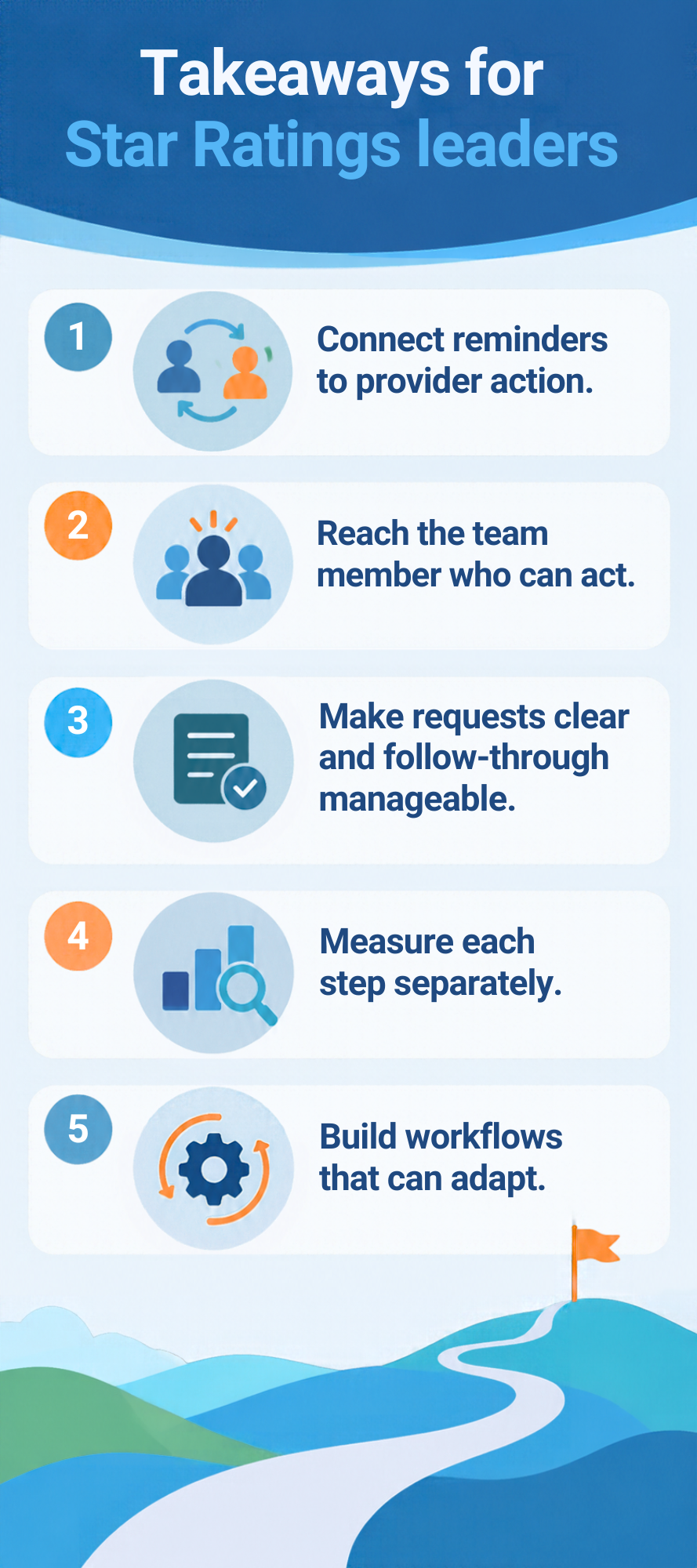
Pair member outreach with provider activation. Connect plan reminders with the care team’s ability to explain, order, schedule, and follow up.
Reach the team member who can act. Match each request to the practice contact responsible for the next step.
Make participation easier. Provide clear requests, defined ownership, and focused response options.
Measure each step separately. Delivery, acknowledgment, action, and documented closure show different kinds of progress.
Build workflows that can adapt. Keep responsibilities, follow-up, and evidence requirements configurable as measures and priorities change.
Connect the plan, the practice, and the next step
careMESH Gap-to-Action brings provider intelligence, managed clinical communication, and care coordination into one configurable offering. It helps plans reach the appropriate care-team contact, organize follow-through, and share progress around the member.
For Star Ratings leaders, the goal is a clearer connection between an identified need and the work required to address it. When plans and practices coordinate that work, outreach becomes more useful to recipients, and more closely connected to the care members need.
Explore careMESH Gap-to-Action for health plans →
References
Coronado GD, et al. Direct-to-member mailed colorectal cancer screening outreach for Medicaid and Medicare enrollees: Implementation and effectiveness outcomes from the BeneFIT study. Cancer. 2020;126(3):540–548. Read the study.
Sequist TD, et al. Patient and physician reminders to promote colorectal cancer screening: A randomized controlled trial. Archives of Internal Medicine. 2009;169(4):364–371. Read the study.
KFF. KFF Tracking Poll on Health Information and Trust: January 2025. Read the findings.
Wernli KJ, et al. Health communication and Stepped Reminders interventions for lung cancer screening: A randomized clinical trial. JAMA Internal Medicine. 2026;186(10):1236–1245. Read the study. Visual abstract corrected October 5, 2026.
Shojania KG, et al. Effect of point-of-care computer reminders on physician behavior: A systematic review. CMAJ. 2010;182(5)–E225. Read the review.
NCQA. HEDIS Electronic Clinical Data Systems frequently asked questions. View reporting guidance.
Contact careMESH today to learn how careMESH can accelerate your product's interoperability strategy.